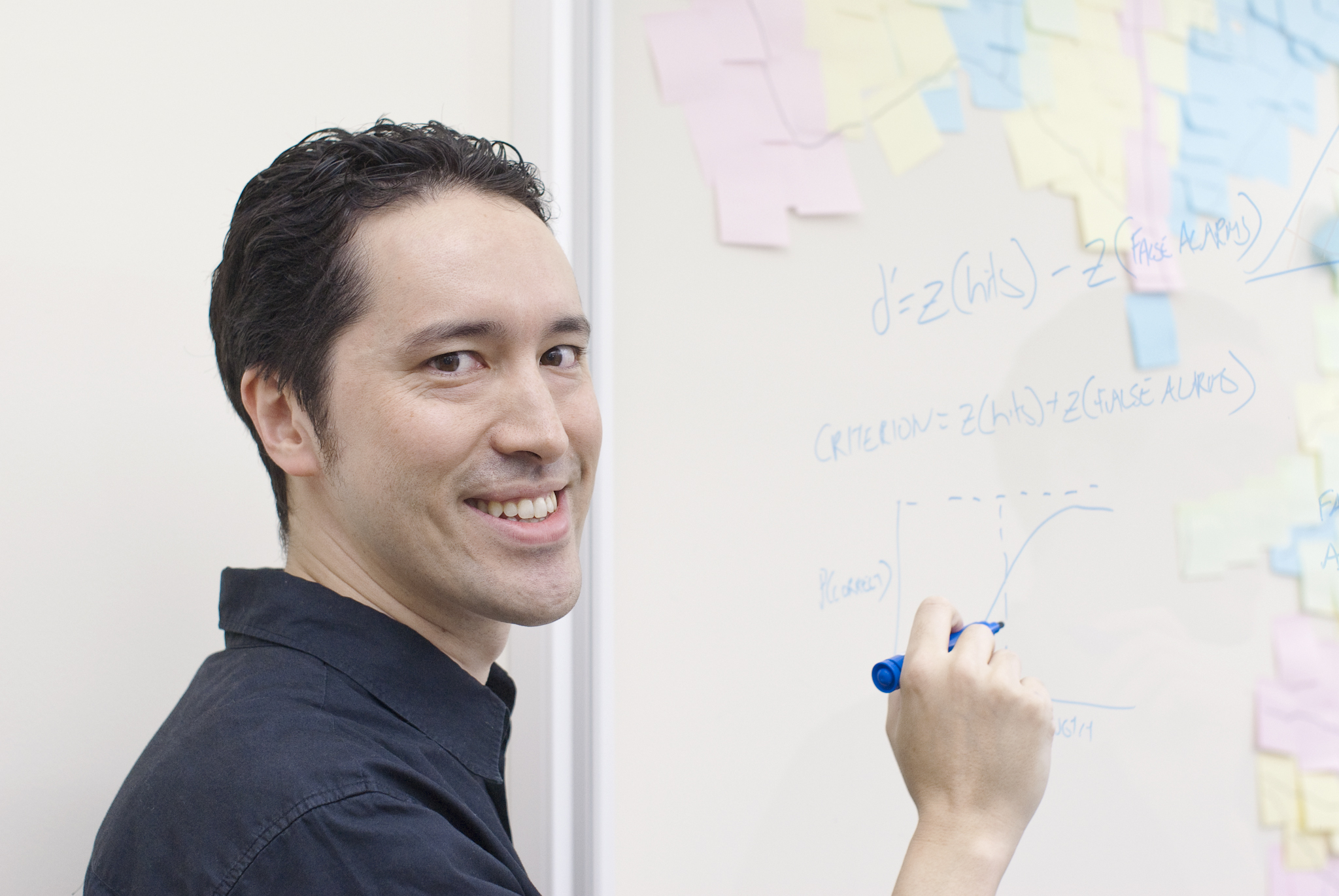
How does neural activity in the human cortex create our sense of visual perception? Our lab at Stanford uses a combination of functional magnetic resonance imaging, computational modeling, and psychophysical measurements to link human perception to cortical brain activity.
More Korea University
M.S. in Cognitive Psychology, 2015
Korea University, B.A. in Psychology, 2012
Jun Hwan (Joshua) Ryu PhD Student
More Stanford, M.S. Computational and Mathematical Engineering, 2022
Yale University, B.A. Cognitive Sicence and Mathematics, 2016
Josh is interested in using neural and psychophysical measurements in order to understand neural mechanisms underlying our visual perception. He is working on developing and validating models of human visuomotor control.
Josh Wilson PhD Student
More UC Berkeley, B.A. Molecular & Cell Biology (Neurobiology) and Cognitive Science 2019
Josh is interested in how we encode, represent, and utilize representations of information in cortex.
Austin Kuo PhD Student
More University of Texas at Austin, B.S. Neuroscience, 2018
Austin is interested in exploring in how representations of low-level visual features, such as spatial frequency, are represented in visual cortex by analyzing neural measurements obtained from fMRI and building computational models to predict neural responses to visual stimuli.